

When it comes to powering everyday electronics, most people are familiar with the classic AA battery. But as more high-performance gadgets enter the market, the 18650 rechargeable lithium battery is becoming an increasingly popular choice. These two cylindrical batteries have differences in size, voltage, chemistry, and capacity; using the wrong battery could damage your device or affect its performance. We'll explain the main distinctions between AA and 18650 batteries in this guide, including a detailed battery 18650 vs aa comparison, so you can confidently choose the right one for your needs.
No, AA and 18650 batteries are not the same. Many users search for answers such as is 18650 battery same as aa, but these two battery types have different specifications and applications. AA batteries are smaller (14.5×50.5mm) and typically provide 1.5V, while 18650 batteries are larger (18×65mm) and deliver 3.6V–3.7V. They also differ in chemistry, capacity, and whether they're rechargeable. Due to these differences, they are not interchangeable, which is an important consideration when evaluating pila 18650 vs aa battery options for different devices.
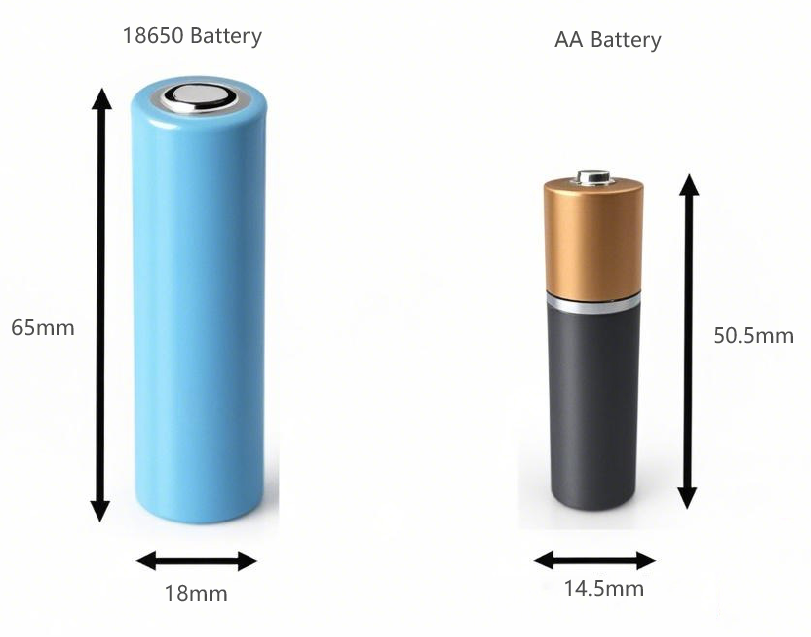
The 18650 rechargeable lithium battery is a cylindrical lithium-ion battery named for its dimensions: 18mm in diameter and 65mm in length, making 18650 vs aa size differences an important factor when selecting the right power source. The 18650 battery size compared to aa shows that 18650 cells are larger but provide significantly higher energy capacity. Known for its high energy density and long cycle life, it’s a popular choice for high-performance devices. 18650 batteries typically offer capacities between 2000mAh and 3500mAh, with some models reaching up to 4000mAh. They are widely used in electric vehicles, power tools, laptops, flashlights, and portable electronics. For industrial applications requiring scalable power, standard 18650 cells serve as the baseline core. You can check our Grade-A 3.7V Lithium Ion Battery cells to view technical datasheets or bulk supply capabilities.
AA batteries are standard cylindrical batteries measuring 14.5mm in diameter and 50.5mm in length. When comparing 18650 battery vs aa battery, size, voltage, and chemistry are the main factors users need to consider. They are commonly used in low to medium-drain devices such as remote controls, toys, digital cameras, and small flashlights. AA batteries come in two main types:
Primary (non-rechargeable): Typically alkaline, with a nominal voltage of 1.5V.
Secondary (rechargeable): Often nickel-metal hydride (NiMH) with a nominal voltage of 1.2V, or less commonly, lithium-ion.
AA batteries generally have lower capacities (1800mAh–2700mAh for NiMH) compared to 18650 batteries, making them less suitable for high-drain applications.
18650 Batteries: Larger size allows for higher capacity, typically ranging from 2000mAh to 3500mAh, with some models reaching 4000mAh. The 18650 vs aa dimensions difference also determines whether a battery can physically fit a specific device. This makes them ideal for devices requiring sustained power.
AA Batteries: Smaller, with rechargeable NiMH AA batteries offering 1800mAh–2700mAh. The 18650 battery vs aa battery size difference also affects capacity, energy output, and compatibility with electronic devices. Alkaline AA batteries have lower effective capacity and are single-use.
18650 Batteries: Nominal voltage of 3.7V (fully charged at 4.2V), providing more power per cell.
AA Batteries: Nominal voltage of 1.2V (NiMH) or 1.5V (alkaline), often requiring multiple cells for higher voltage applications.
The higher voltage of 18650 batteries makes them more efficient for devices like electric vehicles and power tools, reducing the need for multiple batteries in series. This is one of the main differences considered in an aa vs 18650 comparison.
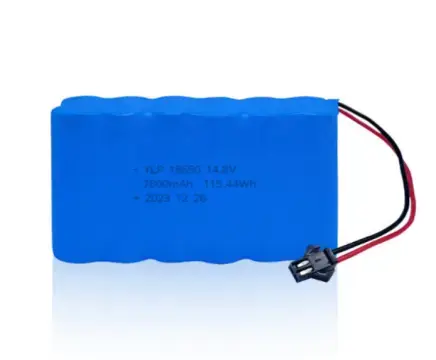
When these cells are micro-welded in a 4-series configuration, they create high-intensity systems like our heavy-duty 14.8V Lithium Ion Battery pack, which is widely sourced for underwater ROVs, professional filming equipment, and medical diagnostic instruments.
18650 Batteries: Use lithium-ion chemistry, offering high energy density and a cycle life of over 1000 charge-discharge cycles. They charge faster and maintain performance over time.
AA Batteries: Typically use alkaline (non-rechargeable) or NiMH (rechargeable) chemistry. NiMH AA batteries have a cycle life of 500–1000 cycles, while alkaline batteries are single-use.
18650 Batteries: Suited for high-drain devices such as electric vehicles, portable electronics, power banks, and cordless power tools. Compared with 18650 batteries vs aa options, they provide higher voltage and energy density for demanding applications.
AA Batteries: Ideal for low to medium-drain devices like remote controls, toys, and small flashlights. Some users compare 18650 aa battery options when looking for alternatives, but the two battery formats serve different application requirements.
For businesses looking to buy batteries in bulk, Yilai Power provides bulk battery suppliers with tailored solutions for various industries.
18650 vs AA Battery Comparison Table Choosing between 18650 batteries and AA batteries depends on factors such as device requirements, voltage, capacity, and application scenarios. The 18650 battery vs aa size comparison is especially important for devices with limited battery compartments or specific size requirements.
Feature | 18650 Battery | AA Battery |
Size | 18mm x 65mm | 14.5mm x 50.5mm |
Capacity | 2000mAh–4000mAh | 1800mAh–2700mAh (NiMH), ~1500mAh (alkaline) |
Voltage | 3.7V (nominal), 4.2V (fully charged) | 1.2V (NiMH), 1.5V (alkaline) |
Chemistry | Lithium-ion | Alkaline, NiMH, or lithium-ion |
Cycle Life | 1000+ cycles | 500–1000 cycles (NiMH), single-use (alkaline) |
Applications | Electric vehicles, power tools, laptops | Remote controls, toys, flashlights |
Custom 18650 Battery Solution
Need More Than a Standard 18650 Cell?
A standard AA battery cannot directly replace an 18650 cell. For equipment requiring specific voltage, runtime, discharge current, dimensions or protection functions, Yilai can develop a custom 18650 battery pack with an appropriate cell configuration, BMS, connector and enclosure.
Explore Custom 18650 Battery Pack Solutions18650 batteries are highly versatile and commonly used to power a variety of devices, including laptops and notebooks, high-powered flashlights, vaping devices, electric vehicles (EV battery packs), power banks, and more.
The capacity of 18650 batteries typically ranges from 2000mAh to 3500mAh, with some high-capacity models reaching up to 4000mAh or more. Higher capacity batteries may have trade-offs, such as lower discharge rates or reduced cycle life. Yilai Power provides a range of 18650 batteries with customizable capacities to meet specific device requirements.
A 3000mAh 18650 battery at 3.7V delivers approximately 11.1 watt-hours (Wh) of energy. This is roughly comparable to the combined output of two to three AA NiMH batteries. This comparison also explains why many users ask are 18650 batteries the same as aa when evaluating battery replacements. For example, three 2000mAh AA batteries at 1.2V provide about 7.2Wh. If you're unsure which battery type suits your application or wonder is an 18650 battery the same as aa, Yilai Power offers custom lithium battery solutions to help you make the right choice.
No, you cannot charge an 18650 battery with an AA charger. The reason is a 18650 battery the same as aa, it is a common misunderstanding, while these batteries require different charging methods and voltage management. 18650 batteries are lithium-ion cells requiring a specific charging profile (4.2V maximum voltage with a constant current-constant voltage method). AA chargers are typically designed for NiMH or alkaline batteries, which have different voltage and charging requirements. Using an AA charger for an 18650 battery can damage the battery or pose safety risks. Yilai Power offers high-quality lithium battery chargers specially designed for 18650 cells, ensuring safe and efficient charging. Our expert engineering team can also assist with custom battery charger solutions to meet your specific application needs.
As a leading Chinese battery company, Yilai Power specializes in producing high-quality lithium-ion batteries, including 18650 rechargeable lithium batteries, lithium polymer batteries, and LiFePO4 batteries. Our battery factory in China adheres to international quality standards, making us a trusted bulk battery supplier for businesses worldwide. Contact us today to learn more about our battery wholesale options and customization solutions.
 en
en
 English
  français
  Deutsch
  Español
  italiano
  português