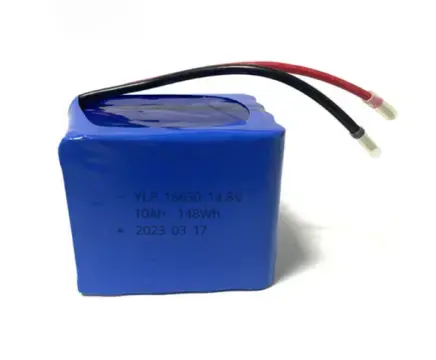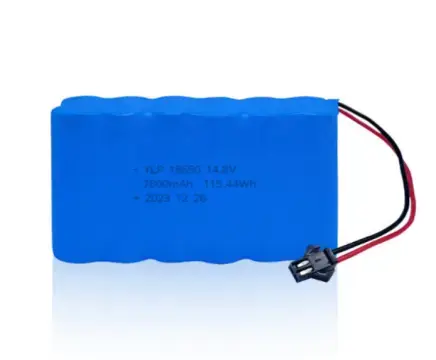


These 14.8V battery packs are widely used in robotics, medical equipment, portable industrial devices, inspection tools, security systems, and other applications requiring long-lasting and dependable power solutions.
As an experienced lithium battery manufacturer, Yilai Power provides OEM and ODM battery pack solutions to help customers develop reliable energy systems based on their specific application requirements.
Flexible customization of voltage, capacity, size, connectors, and battery structure.
Professional battery pack development and manufacturing services for global customers.
Reliable power solutions for robotics, medical, industrial, and portable devices.
Due to their high energy density, stable voltage output, and flexible design options, 14.8V lithium ion battery packs are widely used in industrial and commercial applications where reliable power performance is required.
14.8V battery packs provide stable power output for autonomous robots, inspection robots, AGV systems, and other robotic equipment requiring compact and reliable energy solutions.
Portable medical devices require safe and dependable battery performance. Customized 14.8V lithium battery packs can be designed according to equipment size, power consumption, and operating time requirements.
Industrial tools, inspection systems, monitoring equipment, and portable devices often require lightweight batteries with stable output. 14.8V lithium ion battery packs provide an effective solution for these applications.
Outdoor lighting systems, professional equipment, security devices, and portable electronics benefit from the high energy density and long operating time of customized lithium battery packs.
Every application has different requirements for battery size, capacity, runtime, and installation conditions. Yilai Power provides custom 14.8V lithium ion battery pack solutions to meet different equipment and industry requirements.
From prototype development to mass production, our battery engineering team helps customers select suitable cells, design battery structures, integrate protection systems, and optimize battery performance for their products.
Battery capacity can be customized according to required runtime, power consumption, and application environment.
Customized battery dimensions and internal structures allow the battery pack to fit different equipment designs and limited installation spaces.
Different connectors, cable lengths, and output configurations can be customized according to customer equipment requirements.
Battery protection systems can be customized with suitable functions including overcharge protection, over-discharge protection, over-current protection, and temperature monitoring.
Yilai Power supports OEM and ODM battery pack manufacturing, providing customized lithium battery solutions from design evaluation to production.
A 14.8V lithium ion battery pack is a high-performance rechargeable battery solution designed for equipment that requires stable voltage output, higher energy density, and reliable continuous power supply. Compared with lower voltage battery systems, the 14.8V configuration provides stronger power capability while maintaining a compact and lightweight design.
Typically configured with four lithium cells connected in series (4S), a 14.8V lithium ion battery provides a nominal voltage of 14.8V and a full charging voltage of 16.8V. This configuration is widely used in applications requiring higher power output, including robotics, medical devices, professional equipment, portable industrial tools, inspection systems, and outdoor electronic devices.
For industrial customers, the main advantage of a 14.8V battery pack is its flexibility. Battery manufacturers can customize the capacity, dimensions, connectors, battery structure, and protection system according to different equipment requirements.
Higher Power Output:Provides stable voltage and sufficient power for high-performance equipment.
Higher Energy Density:Stores more energy in a smaller and lighter battery structure compared with traditional lead-acid batteries.
Flexible Battery Design:Supports customized capacity, size, connectors, and battery configurations for OEM projects.
Reliable Protection:Can be integrated with BMS systems to improve safety and extend battery service life.
The performance and safety of a 14.8V lithium ion battery pack depend heavily on the battery management system (BMS) design. Since most 14.8V battery packs use a 4S cell configuration, accurate voltage monitoring and cell balancing are essential.
A professional BMS protects the battery pack from overcharging, over-discharging, excessive current, short circuits, and abnormal temperatures. Proper battery management helps maintain consistent performance and improves the overall cycle life of the battery system.
For customized applications, Yilai Power can develop battery packs with suitable protection solutions according to operating environments, power requirements, and equipment specifications.
| 14.8V Battery Parameter | Typical Specification |
| Battery Configuration | 4S lithium ion battery pack |
| Nominal Voltage | 14.8V |
| Charging Voltage | 16.8V |
| Battery Capacity | Customized according to application requirements |
| Protection System | Customized BMS protection |
Different voltage battery systems are designed for different application requirements. A 14.8V lithium ion battery pack provides a balance between power output, energy density, and size, making it suitable for many industrial and commercial applications.
| Voltage System | Typical Applications | Selection Consideration |
| 7.4V Lithium Battery | Small portable devices and low-power equipment | Suitable for lower energy requirements |
| 11.1V Lithium Battery | Medium-power electronic equipment | Balanced performance for moderate loads |
| 14.8V Lithium Ion Battery | Robotics, industrial equipment, medical devices, professional tools | Higher power output with flexible customization |
| 22.2V Lithium Battery | High-power systems and advanced equipment | Requires higher system voltage design |
Many industrial equipment manufacturers, marine engineers, and energy solution providers are upgrading from traditional 12V lead-acid batteries to customized 14.8V lithium ion battery packs because of their advantages in weight, energy efficiency, and service life.
| Factor | 14.8V Lithium Ion Battery Pack | 12V Lead Acid Battery |
| Energy Density | Higher energy density and lighter design | Lower energy density and heavier structure |
| Cycle Life | Longer service life with proper BMS protection | Shorter lifespan due to battery degradation |
| Customization | OEM customization for voltage, capacity, size and connectors | Limited customization options |


14.8V lithium ion battery packs are suitable for applications that require stable voltage output, high energy density, and reliable power performance, including robotics, medical equipment, portable industrial devices, inspection systems, security equipment, and professional electronic products.
Yes. Yilai Power provides customized 14.8V lithium ion battery pack solutions according to different device requirements. We can customize battery capacity, dimensions, connectors, cable design, output specifications, and protection systems to meet specific application needs.
To develop a suitable 14.8V lithium battery pack, customers usually provide information such as required voltage, capacity, operating current, battery size limitations, charging requirements, working environment, connector type, and expected application.
A 14.8V lithium ion battery pack is typically designed with a 4S cell configuration. Depending on application requirements, different lithium cell models, capacity ranges, and BMS functions can be selected to achieve the required performance, safety, and battery life.
Yes. Yilai Power supports OEM and ODM manufacturing services for customized 14.8V lithium ion battery packs. Our services include battery design, prototype development, customization, testing, and mass production support for global customers.
Depending on customer requirements and application markets, 14.8V lithium ion battery packs can be tested and supplied according to relevant safety and quality requirements, including transportation testing, battery safety evaluation, and compliance documentation.
 en
en
 English
  français
  Deutsch
  Español
  italiano
  português