

 en
en
 English
  français
  Deutsch
  Español
  italiano
  português
 Battery cell matching is the process of selecting and grouping cells with similar capacity, internal resistance, voltage, self-discharge behavior and production history before assembling them into a battery pack. Proper matching helps cells share current more evenly, reach charge and discharge limits at similar times, maintain a more consistent state of charge and age at a more comparable rate. Poorly matched cells can reduce usable pack capacity, increase BMS balancing demand, create uneven heat generation and cause the battery pack to reach its end-of-life earlier than expected. For a reliable custom lithium battery pack, cell selection and matching must be coordinated with pack architecture, BMS design, thermal management and production quality control.
Key Takeaways
A battery pack does not perform like an average cell; its usable performance can be limited by the weakest cell or series group.
Capacity matching helps series-connected cells reach charge and discharge limits at similar times.
Internal-resistance matching helps reduce uneven current distribution and temperature differences, especially in parallel groups.
Voltage matching is important during assembly but does not replace capacity and resistance testing.
Self-discharge screening helps identify cells that may drift out of balance during storage or standby operation.
Cells should normally be matched by model, chemistry, supplier, production batch and state of health.
A BMS can manage limited imbalance, but it cannot fully correct severe cell mismatch or defective cells.
What Is Battery Cell Matching?
Battery cell matching is a quality-control process used to group cells with sufficiently similar electrical and physical characteristics before pack assembly.
Depending on the battery chemistry, cell format and application, matching may consider:
Cell manufacturer and model
Production lot or batch
Nominal and measured capacity
Open-circuit voltage
AC internal resistance or DC internal resistance
Charge and discharge curves
Self-discharge rate
Cell weight and dimensions
State of charge
State of health for reused cells
Temperature behavior under load
The objective is not to find cells that are perfectly identical. Manufacturing processes always produce some level of cell-to-cell variation. The objective is to keep those variations within a controlled range appropriate for the battery architecture and operating requirements.
There is no universal matching tolerance that is correct for every battery pack. The acceptable range depends on factors such as:
Cell chemistry and model
Series and parallel configuration
Maximum charge and discharge current
Required cycle life
BMS balancing capability
Operating temperature range
Application safety requirements
Expected production volume
Matching criteria should therefore be defined as part of the battery pack design and manufacturing plan, rather than copied from a general online guideline.
Why Do Cells from the Same Batch Still Differ?
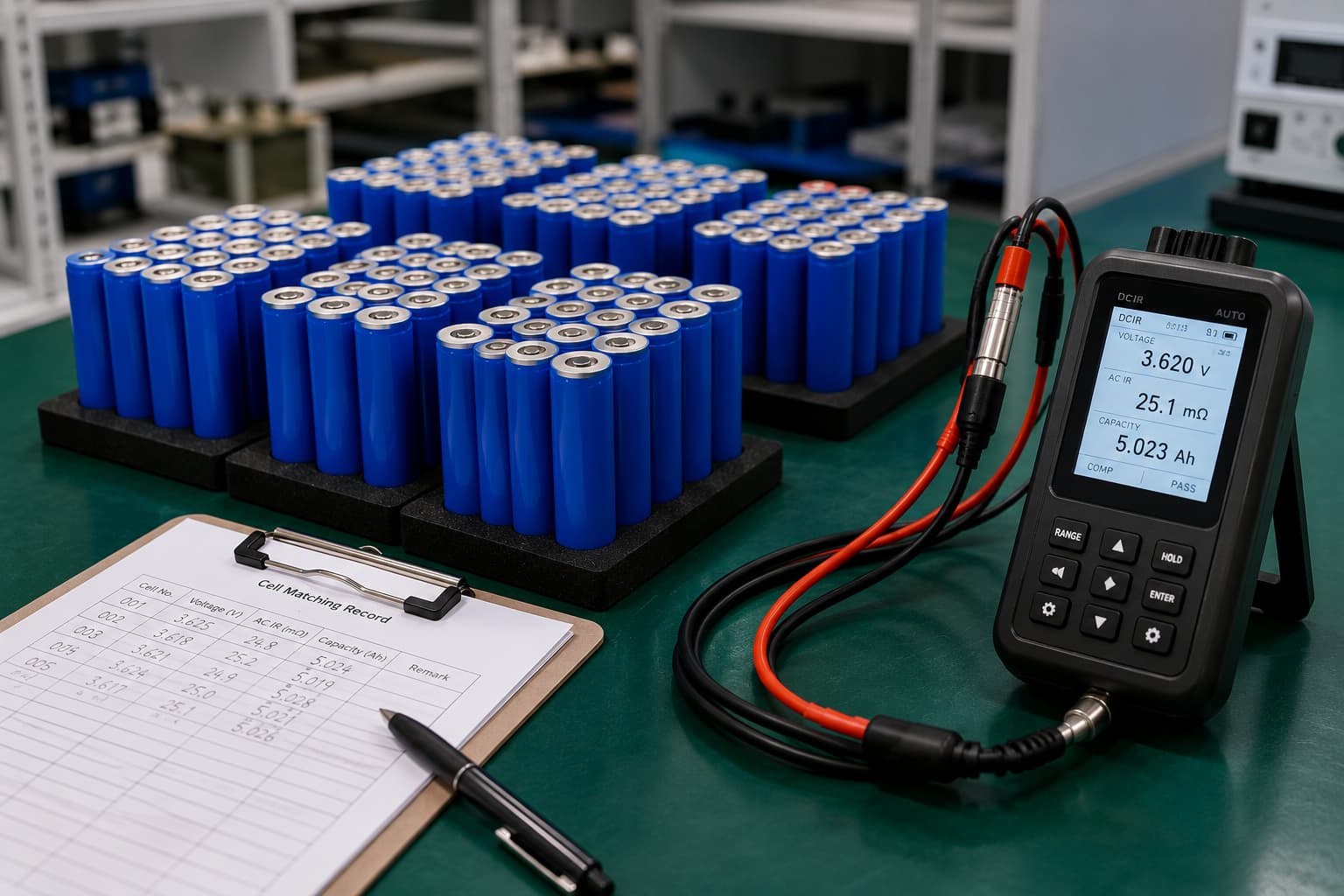
Even cells manufactured on the same production line and within the same lot are not perfectly identical. Small variations can be introduced during electrode coating, material loading, calendaring, electrolyte filling, winding or stacking, formation, aging and final grading.
Cell-to-cell variation may arise from differences in:
Electrode thickness and active-material loading
Electrode porosity and compression
Electrolyte quantity and distribution
Separator alignment
Welding and internal contact resistance
Formation and aging conditions
Storage time and storage temperature
Transportation and handling history
A study involving thousands of fresh lithium-ion cells found measurable cell-to-cell variation even before pack assembly. It also showed that the relationships between capacity, weight and resistance can change with the test rate. Buyers can review the published research on rate-dependent cell-to-cell variation in lithium-ion cells.
This means that checking only the supplier label or rated capacity is not enough for demanding battery-pack projects. Pack manufacturers need incoming inspection and cell-grading procedures appropriate for the application.
How Pack Configuration Changes the Effect of Cell Mismatch
The impact of cell mismatch depends greatly on whether cells are connected in series, parallel or a combination of both.
Cell Mismatch in Series Connections
Cells or parallel groups connected in series carry the same pack current, but they may not have exactly the same capacity or state of charge.
During discharge, the lowest-capacity series group may reach the minimum voltage limit first. The BMS must then stop discharge to protect that group, even if other groups still contain usable energy.
During charging, the group with the highest state of charge or lowest effective capacity may reach the maximum voltage first. The BMS may stop charging or begin balancing before the remaining groups are fully charged.
As a result, one mismatched series group can reduce the usable capacity of the entire pack.
Simple Series-Pack Example
Consider a four-series battery containing three groups with approximately 5.0Ah of usable capacity and one group with only 4.5Ah. Because the same current passes through all four groups, the 4.5Ah group is likely to reach its discharge limit first. The pack may therefore deliver closer to the weakest group's usable capacity rather than the average capacity of all four groups.
Cell Mismatch in Parallel Connections
Parallel-connected cells share the same terminal voltage, but they do not necessarily share current equally.
Current distribution can be affected by:
Cell internal resistance
Connection and weld resistance
Busbar geometry
Cell temperature
Capacity and state-of-charge differences
Terminal position within the module
A lower-resistance cell may initially carry more current than a higher-resistance cell. This can cause the lower-resistance cell to generate more load-related heat and accumulate more charge-throughput over time.
Parallel cells can exchange current and move toward a common terminal voltage, but this natural voltage equalization does not guarantee identical current, temperature or degradation behavior. Sandia National Laboratories has published experimental work showing how module configuration and cell variation influence current sharing in parallel-connected cells. See its presentation on module configuration and lithium-ion battery reliability.
Cell Mismatch in Series-Parallel Packs
Most high-capacity custom battery packs use both series and parallel connections. This creates two consistency requirements:
Cells inside each parallel group should share current as evenly as reasonably possible.
Each parallel group in the series string should have similar capacity, resistance and state of charge.
If one parallel group has lower total capacity or higher resistance, it can become the limiting group for the entire series string.
The arrangement of cells, conductors and sensing wires therefore matters in addition to individual cell matching.
Which Cell Parameters Should Be Matched?
| Matching Parameter | Why It Matters | Possible Effect of Excessive Variation |
|---|---|---|
| Capacity | Determines how much charge each cell or group can store and release | Early charge or discharge cutoff and reduced usable pack capacity |
| Internal Resistance | Affects voltage drop, heat generation and current distribution | Uneven current, uneven temperature and accelerated aging |
| Open-Circuit Voltage | Provides an initial indication of state-of-charge difference | High equalization current or immediate imbalance after assembly |
| Self-Discharge | Shows how quickly a cell loses charge during storage | SOC drift, repeated balancing and standby-capacity loss |
| Charge and Discharge Curve | Shows voltage response across operating SOC and current ranges | Uneven cutoff behavior and inaccurate SOC estimation |
| Temperature Behavior | Affects resistance, current capability and aging rate | Hot spots and increasing divergence over time |
| Production Batch | Helps reduce variation in materials and manufacturing history | Different aging behavior and inconsistent quality records |
| State of Health | Indicates remaining capacity and degradation condition | Premature pack limitation when new and aged cells are mixed |
1. Capacity Matching
Cell capacity describes the amount of charge a cell can deliver under specified test conditions. It is normally expressed in amp-hours or milliamp-hours.
For series-connected cells or groups, capacity mismatch directly affects usable pack capacity. The group that reaches its lower voltage limit first can stop the entire discharge process.
Capacity matching should consider:
The same charge and discharge test conditions
The same cutoff voltages
The same rest periods
The same temperature
The intended application current or a representative grading rate
A capacity value measured at a low current may not fully represent high-power pack behavior. At higher current, voltage drop and internal resistance become more influential.
For that reason, high-power battery projects may require both standard capacity grading and application-relevant discharge testing.
2. Internal-Resistance Matching
Internal resistance affects how much voltage a cell loses under load and how much heat it produces. Although resistance is commonly presented as one value, the measured result depends on the test method, state of charge, temperature and measurement frequency.
Common approaches include:
AC internal resistance measurement
DC pulse resistance measurement
Voltage-drop calculation under a defined load
Electrochemical impedance analysis for advanced evaluation
The test method must be consistent when comparing cells. An AC resistance value should not be directly compared with a DC resistance value obtained under different conditions.
Resistance mismatch is especially important in parallel-connected cells because it can contribute to unequal current sharing. Research published in the Journal of Power Sources examined internal-resistance matching in parallel-connected lithium-ion cells and its impact on pack cycle life.
Pack manufacturers should also control connection resistance. Even well-matched cells can experience uneven current if welds, busbars, cables or terminal positions introduce unequal electrical paths.
3. Open-Circuit Voltage Matching
Open-circuit voltage is often checked before welding or assembling cells. It helps identify cells that are at different states of charge or may have abnormal behavior.
However, voltage matching alone is not sufficient.
Two cells can have nearly the same open-circuit voltage while having different:
Capacities
Internal resistances
Self-discharge rates
State-of-health values
Load-response characteristics
Voltage should therefore be treated as one screening parameter within a broader grading process.
Cells should also be brought to an appropriate and controlled state of charge before being connected in parallel. A large voltage difference can produce an uncontrolled equalization current immediately after connection.
4. Self-Discharge Matching
Self-discharge is the loss of stored charge while a cell is not powering an external load. A cell with abnormal self-discharge may appear acceptable during initial voltage and capacity testing but gradually drift away from the other cells during storage.
Self-discharge screening may involve:
Charging cells under controlled conditions
Allowing an appropriate stabilization period
Recording the initial voltage
Storing cells for a specified time and temperature
Measuring voltage or recoverable capacity again
Separating cells that fall outside the approved range
The screening duration should be defined according to the cell model, project requirements and production process.
Research has shown that differences in self-discharge can have a critical effect on pack behavior and cycle performance. See the peer-reviewed study on the influence of self-discharge variation in lithium-ion cells.
For more background, review Yilai's guide to lithium battery self-discharge.
5. Production Batch and Cell History
Cells used in one battery pack should normally be sourced from the same approved manufacturer, model and controlled production batch.
Mixing cells from different sources can introduce differences in:
Electrode formulation
Rated and actual capacity
Internal construction
Resistance
Charge and discharge curves
Temperature characteristics
Cycle-aging behavior
Even when cells share the same physical size and nominal voltage, they are not necessarily interchangeable.
A battery pack should not combine:
New and used cells
Cells with different states of health
Different cell chemistries
Different cell models without engineering validation
Cells with unknown storage or usage history
For B2B projects, buyers should ask how the battery manufacturer controls cell suppliers, incoming batch records and substitutions.
How Poor Cell Matching Reduces Usable Pack Capacity
A pack's nameplate capacity does not guarantee that all rated energy can be used under every condition. In a series-connected pack, the BMS must protect each series group from overcharge and over-discharge.
If one group has lower capacity, it can:
Reach maximum voltage earlier during charging
Reach minimum voltage earlier during discharging
Trigger BMS protection before other groups are fully utilized
Increase balancing time near the top of charge
Reduce runtime available to the equipment

The customer may then observe:
Shorter-than-expected operating time
Premature low-battery shutdown
Charging that stops before the expected energy is stored
Increasing voltage spread between series groups
This is sometimes described as the weakest-cell or weakest-group effect.
How Internal-Resistance Variation Creates Uneven Heat
Heat generation under load is influenced by current and resistance. When cells or electrical paths differ, the current and heat may not be distributed evenly.
Uneven temperature matters because cell aging is temperature-dependent. A cell operating consistently hotter than neighboring cells may degrade faster, causing its resistance and capacity to diverge further.
This can create a reinforcing cycle:
Initial cell or connection resistance differs.
Current and heat distribution become uneven.
Hotter or more heavily loaded cells age faster.
Their resistance and capacity change further.
Pack inconsistency increases with continued cycling.
Cell matching must therefore be supported by effective thermal design. Sandia notes that minimizing temperature spread between cells helps minimize variation in performance and degradation. Its technical chapter on lithium-ion battery performance and thermal management provides additional background.
How Cell Mismatch Affects Cycle Life
Battery cycle life is normally defined under specified charge, discharge, temperature and end-of-life conditions. Pack cycle life can be shorter than individual-cell test data suggest when cells do not age uniformly.
Mismatch can shorten effective pack life through:
Uneven current loading
Uneven depth of discharge
Repeated operation near voltage limits
Excessive balancing near full charge
Uneven temperature
Higher stress on a weak series group
Increasing SOC estimation error
The pack may reach end-of-life when one cell or group can no longer meet capacity, power or voltage requirements, even if most other cells remain usable.
Cell matching does not eliminate aging. Instead, it helps reduce avoidable differences in how cells are loaded and degraded.
Can a BMS Correct Poor Cell Matching?
A BMS is essential for monitoring and protecting most multi-cell lithium battery packs, but it should not be treated as a replacement for cell quality and matching.
A BMS may provide:
Cell-voltage monitoring
Pack-current monitoring
Temperature monitoring
Overcharge and over-discharge protection
Overcurrent and short-circuit protection
Passive or active cell balancing
State-of-charge estimation
Fault recording
Passive Balancing
Passive balancing usually removes a limited amount of energy from higher-voltage groups, commonly through resistive dissipation. It can correct relatively small differences, particularly near the top of charge.
However, passive balancing:
Cannot restore lost cell capacity
Cannot repair a high-resistance cell
Cannot correct abnormal self-discharge permanently
May require long balancing time when mismatch is large
Generates heat while dissipating energy
Active Balancing
Active balancing transfers energy between cells or groups and may support larger battery systems or applications requiring better energy utilization.
It can improve balance management, but it still cannot make a damaged, aged or incorrectly selected cell equivalent to a healthy matched cell.
For more information, review why multi-cell lithium battery packs need a BMS.
Cell Matching vs Cell Balancing
| Process | When It Occurs | Main Purpose | What It Cannot Do |
|---|---|---|---|
| Cell Matching | Before battery pack assembly | Select cells with similar characteristics | Prevent all future aging differences |
| Cell Balancing | During charging or operation | Reduce differences in series-group SOC or voltage | Repair capacity loss, high resistance or defective cells |
A reliable battery system normally needs both appropriate cell matching and suitable BMS balancing.
What Does a Professional Cell-Grading Process Include?
The exact production process varies by cell type and project, but a professional cell-grading workflow may include the following stages.
1. Supplier and Batch Verification
Confirm approved cell manufacturer and model
Record production lot and receiving date
Review cell specification and available compliance documents
Check packaging and transportation condition
2. Incoming Visual and Dimensional Inspection
Inspect dents, deformation, corrosion or leakage
Check terminal condition
Measure key dimensions where required
Verify marking and model identification
3. Initial Voltage and Resistance Testing
Measure open-circuit voltage
Measure internal resistance using a controlled method
Separate abnormal or out-of-range cells
4. Capacity Grading
Charge under specified conditions
Allow controlled rest time
Discharge at a defined rate
Record delivered capacity and voltage curve
Group cells according to approved capacity ranges
5. Self-Discharge Screening
Store cells under controlled time and temperature conditions
Recheck voltage or recoverable capacity
Remove cells with abnormal charge loss
6. Final Grouping and Traceability
Group cells by capacity, resistance and voltage
Maintain production batch consistency
Assign cells or groups to a pack-production lot
Retain inspection and grading records
The required depth of grading should be determined by the battery application. A low-current consumer product and a high-power industrial robot do not necessarily need identical screening methods.
How Should Cells Be Matched for Different Applications?
High-Power Battery Packs
Battery packs for robots, power tools, drones, pumps and motor-driven equipment require close attention to:
DC resistance under representative SOC and temperature
Peak-current capability
Voltage sag
Temperature rise
Connection resistance
Long-Runtime Battery Packs
For monitoring equipment, medical devices and portable instruments, key factors may include:
Measured capacity
Self-discharge
Low-current efficiency
Standby consumption
SOC estimation accuracy
LongSOC estimation accuracy
SOC estimation accuracy
Long-Cycle-Life Battery Packs
For LiFePO4 and frequently cycled industrial systems, manufacturers should consider:
Initial capacity and resistance
Temperature uniformity
Charge and discharge rate
Depth of discharge
Balancing strategy
Expected degradation consistency
Low-Temperature Battery Packs
Cell resistance increases at low temperatures, making differences between cells more significant. Low-temperature projects may therefore require:
Testing at the actual operating temperature
Low-temperature cell selection
Charging-temperature protection
Heating and thermal-control evaluation
Careful voltage-sag analysis
Why Connection Resistance Matters as Much as Cell Matching
A battery pack can contain well-matched cells and still experience uneven performance if electrical connections are inconsistent.
Connection resistance can be affected by:
Spot-weld quality
Laser-weld quality
Nickel-strip thickness
Busbar material and dimensions
Cable length and wire gauge
Connector contact resistance
Terminal position
Fastener torque
Pack validation should therefore examine the entire electrical path, not only the cell data.
For high-current systems, the manufacturer may need to verify voltage drop, temperature rise and current distribution at the module or pack level.
What Battery Pack Buyers Should Ask Their Manufacturer
When evaluating a custom battery pack manufacturer, B2B buyers can ask:
Which cell manufacturers and models are approved for this project?
Will all cells come from the same production batch?
Which parameters are tested during incoming inspection?
How are capacity and internal resistance measured?
What matching ranges are used for this specific battery design?
Is self-discharge screening performed?
How are cell-grading results recorded?
How is pack-level voltage and temperature consistency tested?
How are cell or component substitutions controlled?
Can production batches be traced to cell and inspection records?
The manufacturer may not disclose proprietary grading limits, but it should be able to explain the process, equipment, acceptance logic and quality records used for the project.
Cell-Matching Information to Include in a Custom Battery RFQ
Buyers do not normally need to define the final cell-matching limits themselves. However, the RFQ should provide enough information for the manufacturer to establish appropriate limits.
Include:
Battery chemistry
Preferred cell manufacturer or model
Series-parallel configuration, if already defined
Maximum continuous current
Peak current and duration
Charging current
Expected runtime
Operating temperature
Target cycle life
Allowed voltage drop
Required BMS balancing method
Traceability and reporting requirements
For a complete project checklist, see how to prepare a custom lithium battery pack RFQ.
Common Cell-Matching Mistakes
Matching Cells by Voltage Only
Similar open-circuit voltage does not prove that cells have similar capacity, resistance or self-discharge behavior.
Mixing New and Used Cells
Used cells may have different capacity, resistance and degradation histories even when their voltage appears normal.
Using Cells from Different Models or Manufacturers
Cells with the same dimensions and nominal voltage may have different internal designs, current ratings and aging characteristics.
Ignoring Self-Discharge
A cell with abnormal self-discharge can cause increasing imbalance during storage or standby operation.
Assuming the BMS Will Fix Everything
Balancing cannot restore lost capacity or repair a high-resistance or defective cell.
Ignoring Weld and Busbar Resistance
Unequal electrical paths can create current imbalance even when individual cells were matched correctly.
Using Fixed Matching Limits for Every Project
Matching criteria should reflect the cell model, pack configuration, current, temperature, cycle-life objective and application risk.
How Yilai Approaches Cell Consistency in Custom Battery Packs
For custom battery projects, Yilai evaluates cell consistency together with the electrical load, series-parallel configuration, BMS functions, thermal environment and production requirements.
Project-based quality controls may include:
Approved cell supplier and model selection
Production-batch verification
Visual and electrical incoming inspection
Open-circuit voltage testing
Internal-resistance testing
Capacity grading
Cell grouping according to approved project criteria
Charge and discharge testing after assembly
Series-group voltage monitoring
BMS balancing and protection verification
Aging testing
Batch and production traceability
The exact inspection and matching plan should be confirmed for each project. High-current, long-cycle, low-temperature and safety-critical applications may require additional testing.
Yilai supplies custom lithium-ion battery packs based on cylindrical and other cell formats. Buyers comparing cylindrical cells can also review the 21700 vs 18650 battery selection guide.
Battery Cell Matching FAQ
What does battery cell matching mean?
Battery cell matching means measuring and grouping cells with similar characteristics, such as capacity, internal resistance, voltage, self-discharge and production history, before assembling them into a battery pack.
Why should cells in a series battery pack have similar capacity?
The same current passes through all series-connected cells or groups. A lower-capacity group may reach its charge or discharge voltage limit first, reducing the usable capacity of the complete pack.
Why is internal resistance important in parallel-connected cells?
Differences in cell and connection resistance can contribute to unequal current sharing, voltage drop and heat generation. Over time, uneven loading may lead to different degradation rates.
Is matching cells by voltage enough?
No. Voltage matching helps control initial state-of-charge differences, but cells with similar voltage may still have different capacity, resistance, self-discharge and state of health.
Can a BMS compensate for cell mismatch?
A BMS can monitor cells and correct limited state-of-charge imbalance through balancing. It cannot restore lost capacity, reduce the internal resistance of a degraded cell or permanently correct abnormal self-discharge.
Should battery packs use cells from the same batch?
Using cells from the same approved manufacturer, model and controlled production batch helps reduce variation in materials, manufacturing history and electrical behavior.
Can new cells be mixed with used cells?
New and used cells should generally not be mixed in the same battery pack because they are likely to have different capacities, resistances and degradation histories.
How are battery cells matched in production?
The process may include supplier verification, visual inspection, voltage testing, internal-resistance testing, capacity grading, self-discharge screening and grouping according to project-specific acceptance ranges.
Need a Consistent Custom Lithium Battery Pack?
```Send Yilai your application, voltage, capacity, continuous and peak current, pack dimensions, operating temperature, target cycle life and estimated order quantity. Our engineering team can evaluate the appropriate cell format, series-parallel configuration, BMS functions, matching requirements and production-validation plan.
Explore Custom Battery Solutions Request a Battery Design Review
```