

All lithium batteries are composed of four key components:
Cathode: Determines energy density and cycle characteristics (ternary lithium uses nickel-cobalt-manganese/aluminum; LiFePO₄ uses lithium iron phosphate).
Anode: Typically graphite, responsible for lithium-ion intercalation/deintercalation.
Electrolyte: Conducts ions. Ternary lithium often uses carbonate solvents, while LiFePO₄ requires high-temperature-resistant formulations.
Separator: Isolates the cathode and anode. Pore size is controlled between 10–20μm to balance conductivity and safety.
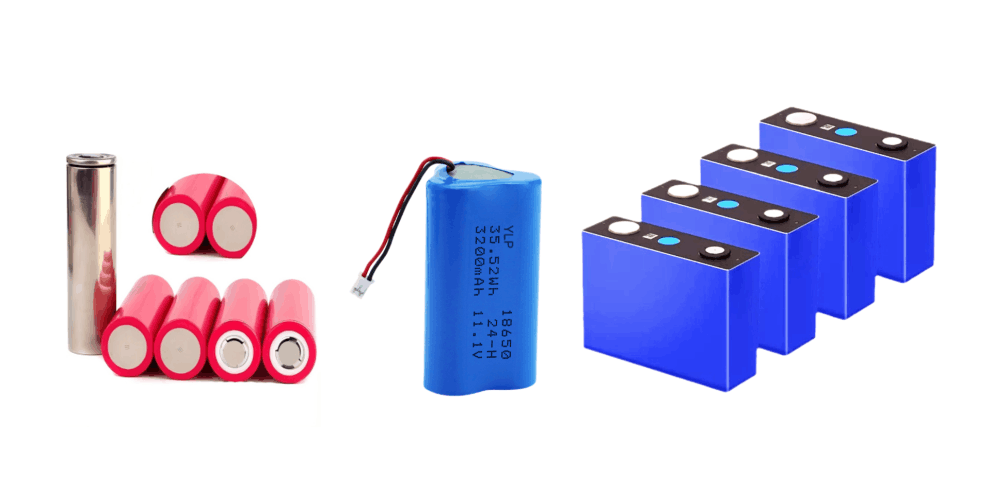
Power-Type Cells: Focus on high instantaneous power output, featuring low internal resistance (<5mΩ) and high discharge rates (supports over 10C). Ideal for power tools and electric vehicles. Ternary lithium cells can reach peak discharge rates of 20C.
Energy-Type Cells: Emphasize long endurance and stable energy storage, with high capacity density (>200Wh/kg). Suitable for smartphones, laptops, and energy storage stations. LiFePO₄ is a typical representative, with cycle life exceeding 2,000 cycles.
| Technical Indicator | Ternary Lithium Battery (NMC) | LiFePO₄ Battery (LFP) | Core Differences |
| Nominal Voltage | 3.6V (platform: 3.6V) | 3.2V (platform: 3.2V) | Ternary lithium offers 15–20% higher energy density |
| Energy Density | 180–260 Wh/kg | 90–130 Wh/kg | Ternary lithium is better for lightweight devices |
| Cycle Life | 800–1,500 cycles | 2,000–5,000 cycles | LiFePO₄ has 2–3x the lifespan |
| Charge/Discharge Temp | Charge: -25℃~60℃ | Charge: 0℃~55℃ | Ternary performs better in low temperatures |
| Safety | Thermal runaway > 200℃ | Thermal runaway > 300℃ | LiFePO₄ has 30% better high-temp resistance |
| Typical Weight | 21700 cell ~50g | Same capacity ~65g | Ternary is lighter, ideal for portable applications |
When evaluating different battery chemistries, understanding the differences between ternary lithium vs lifepo4 is essential for selecting the right solution based on energy density, safety, cycle life, and application requirements.
Ternary Lithium Advantages:
Better low-temp performance: range degrades <25% at -10℃, suitable for cold northern climates.
Supports fast charging: up to 3C charging (80% in 30 minutes), ideal for frequent public charging stations.
LiFePO₄ Advantages:
Longer cycle life: retains 85% capacity after 5,000 cycles; optimal for taxis and ride-sharing vehicles.
Lower cost: material cost is 30% less than ternary lithium, reducing overall battery pack expenses.
Core Needs: High current discharge (10C+), lightweight design.
Best Choice: Many ternary lithium power cells support discharge rates of 25C or higher, with voltage fluctuation <5% during startup, reducing drone instability risks.
LiFePO₄ Preferred:
Economic over lifecycle: 2,000+ cycles, Levelized Cost of Electricity (LCOE) 40% lower than lead-acid.
High safety: Passed UL9540A thermal runaway tests; paired with BMS for 0.1℃-level temperature monitoring.
Typical Setup: 256S 120Ah LiFePO₄ modules, scalable to 1MWh with parallel expansion; compatible with PV/grid hybrid systems.
Ternary Lithium Advantages:
Compact and easy to install: 30% smaller volume at the same capacity, ideal for wall-mounted home systems.
Low self-discharge: <3% per month, ensuring reliable standby during outages.
Ternary Lithium Dominates:
High energy density: 3.7V platform; 3,000mAh cells as thin as 4.5mm, perfect for ultra-slim designs.
Fast-charging compatibility: Supports PD/QC protocols; 18W charging achieves 60% in 30 minutes.
LiFePO₄ Potential:
Wide temperature range: Stable discharge from -20℃ to 60℃; outdoor cameras can operate for 8 hours even in cold winters.
Deep discharge protection: Supports cutoff voltage as low as 2.5V, preventing over-discharge damage and extending device lifespan.
Q1: Why is LiFePO₄ better for energy storage stations?
A1: Lifecycle economics is the key:
Longer lifespan: 5,000 cycles vs. 1,000 for ternary lithium, reducing replacement costs by 60%.
Superior safety: 100℃ higher thermal runaway threshold; with BMS, system-level safety improves 3x.
Material stability: When comparing ternary lithium battery vs lifepo4, LiFePO₄ cathodes have <10% price volatility, compared to >50% for cobalt in ternary lithium.
Q2: Can ternary lithium batteries operate at -40℃?
A2: Standard ternary lithium retains only ~30% capacity at -40℃. Customized solutions can meet such extreme needs.
Q3: Can ternary lithium and LiFePO₄ be used together?
A3: Direct hybrid use is prohibited! The two have different voltage platforms and charge/discharge characteristics. Mixing them in series may cause overcharge in ternary cells and system imbalance. Proper practice is to group cells of the same type, each managed by an independent BMS.
Ternary lithium and LiFePO₄ batteries are not competitors, but complementary solutions:
For high energy density and cold-weather performance: Choose ternary lithium (EVs, drones, 3C electronics).
For long lifespan and cost-efficiency: Choose LiFePO₄ (energy storage, commercial vehicles, backup power).
As a professional battery solution provider, Yilai Technology has been deeply involved in the battery field for over a decade. With strong technical foundations and extensive practical experience, we offer the following core services:
Custom Cell Design: Tailored battery solutions to match project requirements, balancing performance and cost.
System Integration: Turnkey solutions including design, assembly, and commissioning to ensure efficient and stable operation.
Extreme Environment Adaptation: Specialized solutions for high-cold, high-heat, and other harsh environments to ensure battery reliability.
Contact Us: Tel:0755-29300814
WhatsApp:+86 158 1850 9713
Email:tracy.qin@yilaipower.com
Add:Blding B, Tianxia International Center, No. 8 Taoyuan Rd, Nanshan, Shenzhen, PRC
 en
en
 English
  français
  Deutsch
  Español
  italiano
  português