

 en
en
 English
  français
  Deutsch
  Español
  italiano
  português
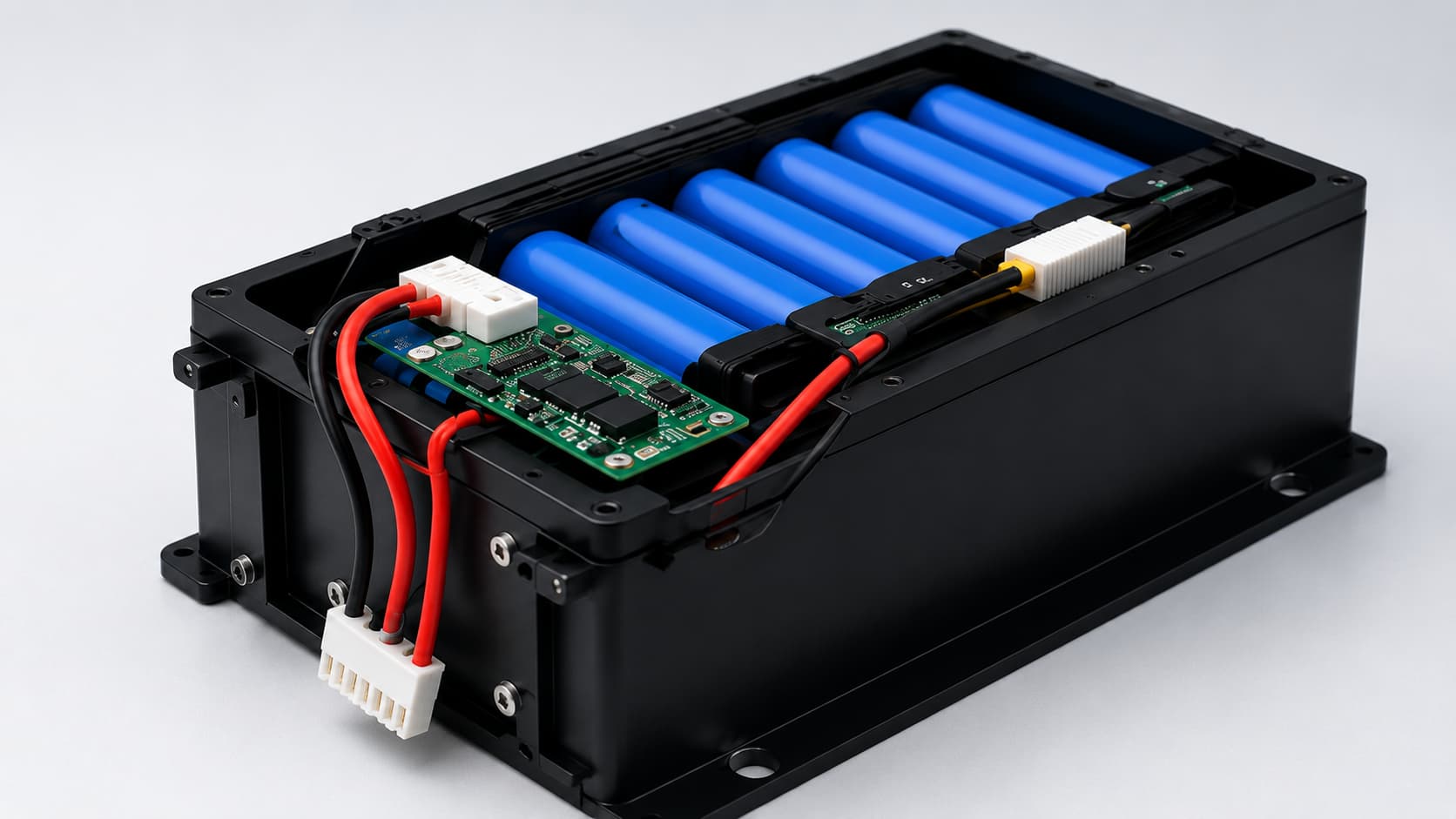
 A complete custom lithium battery pack RFQ should clearly define the application, voltage, capacity, continuous and peak current, available installation space, operating temperature, BMS functions, communication requirements, certification needs and estimated order quantity. The more accurate this information is, the easier it is for a battery manufacturer to evaluate cell chemistry, series-parallel configuration, enclosure design, safety protection, development cost and prototype lead time. An incomplete RFQ often leads to repeated questions, inaccurate quotations and avoidable prototype revisions. This guide explains what OEM buyers and engineers should include when requesting a custom lithium battery pack quotation.
Custom Battery Pack RFQ Checklist at a Glance
Application and equipment description
Nominal voltage and charging voltage
Required capacity and target runtime
Continuous and peak discharge current
Maximum dimensions and weight
Operating and storage temperature
Preferred battery chemistry and cell format
BMS protection and communication requirements
Connector, cable and charging interface
Enclosure and environmental protection
Target market and certification requirements
Prototype quantity and estimated annual demand
Target schedule, budget and supporting files
Why Is a Detailed Battery Pack RFQ Important?
A custom battery pack cannot be accurately quoted from voltage and capacity alone. Two packs with the same voltage and amp-hour rating may require completely different cells, BMS designs, conductors, connectors, enclosures and testing procedures.
For example, a 24V battery used in a stationary monitoring device may operate under a stable low-current load. A 24V battery for a mobile robot may need to handle motor-starting current, vibration, frequent charging and communication with the robot controller. Although their basic voltage and capacity may look similar, their engineering and production requirements are different.
A detailed RFQ helps the battery manufacturer:
Select a suitable battery chemistry and cell format
Calculate an appropriate series-parallel configuration
Evaluate continuous and peak current capability
Define BMS protection thresholds and communication functions
Confirm whether the battery will fit inside the equipment
Assess thermal, vibration, waterproofing and environmental requirements
Identify applicable testing and certification requirements
Estimate tooling, prototype and mass-production costs
Provide a more realistic development and delivery schedule
Preparing this information before contacting a custom battery pack manufacturer can substantially reduce back-and-forth communication during the early engineering stage.
1. Describe the Application and Operating Profile
Begin the RFQ by explaining what the battery will power. Avoid using descriptions such as “industrial equipment” or “smart device” without further details. The battery manufacturer needs to understand the actual operating profile of the equipment.
Include the following information:
Equipment type and primary function
Whether the product is portable, stationary or vehicle-mounted
Typical daily operating time
Frequency of charging and discharging
Normal load and maximum load
Whether the equipment includes motors, pumps, heaters or transmitters
Whether the battery is removable or built into the equipment
Whether the product is used indoors, outdoors, underwater or in a vehicle
Target country or market
It is also useful to provide a brief description of the operating sequence. A robot, for example, may have a low standby load, a moderate cruising load and a much higher current demand during acceleration. This load profile affects cell selection, conductor size, BMS current ratings and pack configuration.
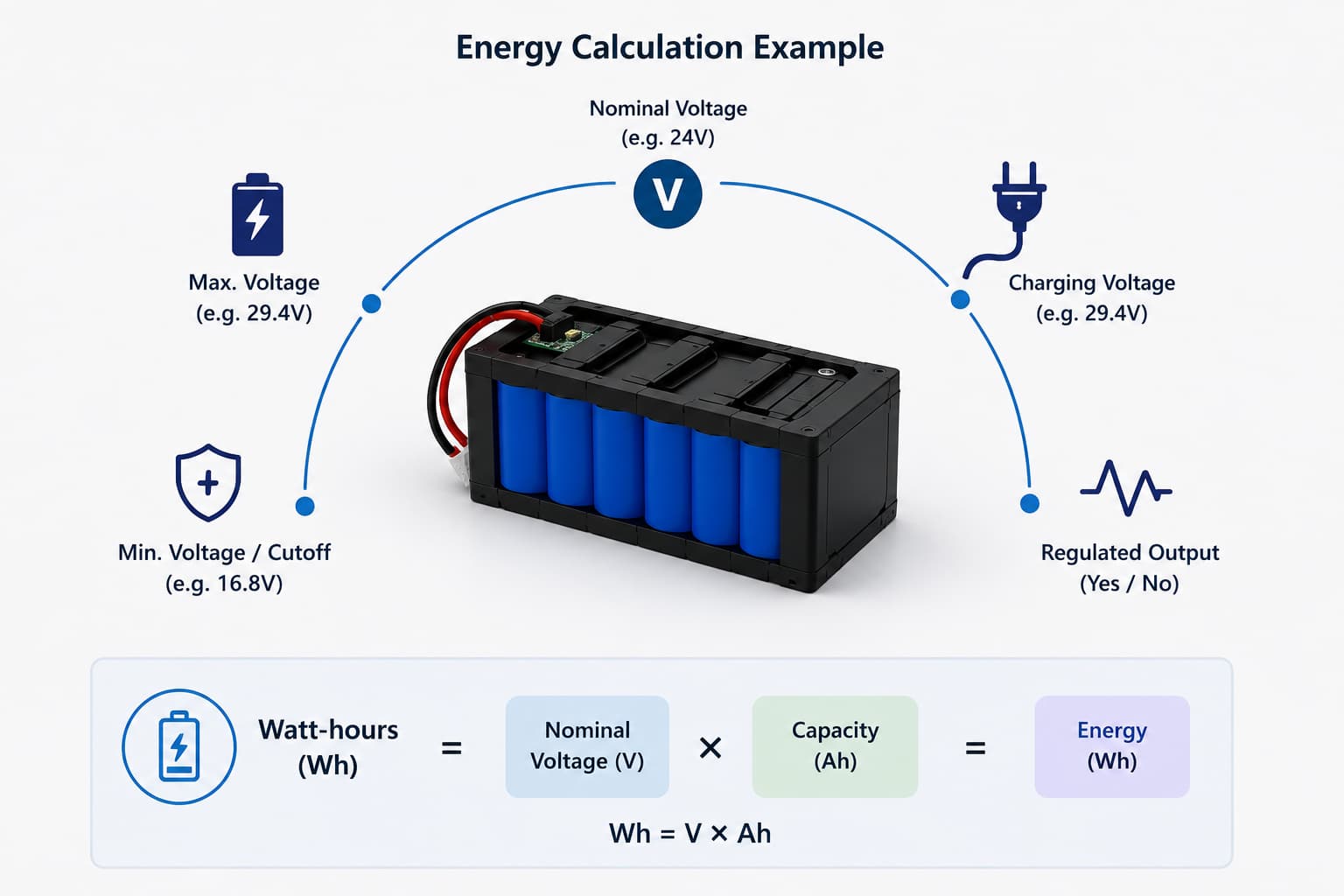
2. Specify Nominal Voltage and Charging Voltage
State the nominal battery voltage required by the equipment. Where available, also provide the acceptable input-voltage range of the device rather than only a single nominal value.
The RFQ should clarify:
Required nominal voltage
Maximum acceptable voltage
Minimum operating or cutoff voltage
Required charging voltage
Whether regulated output is required
Whether the new battery must replace an existing battery
The battery chemistry determines the voltage of each cell, while the series configuration determines the pack voltage. A lithium-ion pack, LiFePO4 pack and lithium polymer pack may require different cell counts and charging systems even when they are intended for similar equipment.
If the equipment is currently powered by another battery, include the original battery label, specification sheet and measured voltage range. Do not assume that a battery with a similar nominal voltage is automatically compatible with the device.
3. Define Capacity and Required Runtime
Battery capacity is normally expressed in amp-hours or milliamp-hours, but capacity alone does not completely describe the energy available to the equipment. Voltage and capacity together determine the nominal watt-hour rating:
Watt-hours (Wh) = Nominal voltage (V) × Capacity (Ah)
When preparing the RFQ, provide:
Required capacity in Ah or mAh
Target operating time per charge
Typical equipment power consumption
Maximum equipment power consumption
Acceptable depth of discharge
Expected standby time
Target battery service life
If the precise capacity is unknown, provide the equipment's average current or power consumption and the required runtime. The battery engineering team can then make an initial energy estimate while accounting for conversion losses, cutoff settings, temperature and aging margins.
For projects where installation space is limited, the required runtime may need to be balanced against battery dimensions, weight and discharge capability.
4. Provide Continuous and Peak Current Requirements
Current requirements are among the most frequently omitted items in custom battery RFQs. They are also critical to battery safety and performance.
Include:
Average operating current
Maximum continuous discharge current
Peak or surge current
Duration of each peak-current event
Frequency of peak-current events
Maximum charging current
Whether regenerative charging may occur
Motors, compressors, pumps, radio transmitters and heating elements may produce a peak load significantly higher than the normal operating current. If only the average current is provided, the proposed battery may trigger overcurrent protection or experience excessive voltage drop when the equipment starts.
A load profile, oscilloscope record or current measurement from the existing equipment can help the manufacturer select suitable cells, nickel strips, busbars, wires, connectors and BMS components.
5. Define Maximum Dimensions, Shape and Weight
Provide the maximum space available for the battery rather than asking the manufacturer to make the pack “as small as possible.” The dimensions should include the space needed for cells, BMS, insulation, wiring, connectors, enclosure walls and manufacturing tolerances.
Specify:
Maximum length, width and height
Maximum permitted weight
Required battery shape
Connector exit direction
Cable routing and cable length
Mounting holes, brackets or fixing points
Accessible service or charging areas
Clearance around the battery
Where possible, submit a 2D drawing, STEP/STP file, equipment enclosure drawing or photograph with dimensions. For an irregular or thin battery compartment, a custom lithium polymer battery may offer more dimensional flexibility than a pack based on cylindrical cells.
6. Indicate the Preferred Battery Chemistry and Cell Format
Buyers may specify a preferred chemistry, but the final selection should be based on the application rather than familiarity with a particular cell type.
| Battery Option | Typical RFQ Considerations |
|---|---|
| Lithium-Ion | Energy density, current capability, cylindrical cell availability and flexible series-parallel configurations |
| Lithium Polymer | Thin profiles, irregular spaces, low weight and customized pouch-cell dimensions |
| LiFePO4 | Cycle life, thermal stability, high-capacity systems and industrial or energy applications |
If a cell brand or model has already been approved, include it in the RFQ. Also indicate whether alternative cells can be evaluated to improve availability, cost or performance.
Yilai provides multiple lithium-ion battery pack configurations based on 18650, 21700 and other cell formats. For higher-capacity or longer-cycle applications, buyers can also review available custom LiFePO4 battery packs.
7. List Required BMS Functions
A battery management system should be selected around the final cell configuration and equipment requirements. Do not simply request “a standard BMS” when the application requires specific protection, monitoring or communication functions.
The RFQ should identify whether the battery needs:
Overcharge protection
Over-discharge protection
Overcurrent protection
Short-circuit protection
Charging and discharging temperature protection
Cell-voltage monitoring
Cell balancing
State-of-charge monitoring
Fuel-gauge functionality
Cycle-count recording
Fault or alarm output
Charge and discharge switching control
For further background on when battery management is required, see Yilai's guide on whether a lithium battery needs a BMS.
8. Define Communication and Software Requirements
Smart battery projects should clearly describe how the battery communicates with the host device, charger or monitoring system.
Include:
Required protocol, such as CAN, RS485, UART, SMBus or I²C
Communication voltage level
Connector pin definition
Required battery data
Data refresh rate
Fault codes and alarm logic
Sleep and wake-up requirements
Charging communication requirements
Existing protocol documents or CAN database files
State whether the manufacturer must follow an existing communication protocol or develop one for the project. Software development, debugging and host-system integration can affect prototype cost and lead time.
9. Specify Connector, Cable and Charger Requirements
Connector and cable details should be included early because they affect current capacity, voltage drop, installation and tooling.
Provide:
Connector manufacturer and part number
Number of pins and pin definition
Wire gauge
Cable length
Terminal or lug type
Fuse requirements
Charge and discharge port arrangement
Required plug orientation
If a charger is required, specify the input voltage, market plug type, desired charging current, charging-time target, connector and any communication requirements. A charger should match the battery chemistry, series count and approved charging profile.
10. Explain the Operating Environment
The battery manufacturer must understand the environment in which the finished pack will be stored, charged and discharged.
Include:
Charging temperature range
Discharging temperature range
Storage temperature range
Humidity conditions
Altitude, where relevant
Exposure to water, dust, salt mist or chemicals
Expected vibration, shock or drop conditions
Whether the pack is installed in a sealed enclosure
Required IP rating
Outdoor, marine and underwater applications may require sealing, potting, waterproof connectors, corrosion-resistant materials or a dedicated enclosure. Low-temperature charging may also require different cells, charging controls or an integrated heating function.
11. Identify Certification and Transportation Requirements
Certification requirements should be discussed before cell selection and prototype development. Testing may affect the battery structure, components, documentation, budget and project schedule.
Provide the following information:
Target countries or sales regions
Product category
Required battery safety standards
Transportation method
Whether the battery is shipped separately, packed with equipment or installed in equipment
Required documentation and test reports
UN 38.3 addresses tests used in the classification of lithium cells and batteries for transportation. Buyers can consult the UNECE Manual of Tests and Criteria resources for official information.
For air transport, packaging, state-of-charge, marking and documentation requirements can vary according to battery configuration and watt-hour rating. The IATA lithium battery guidance page provides updated industry resources.
Companies shipping batteries to or within the United States can also review the PHMSA Lithium Battery Guide for Shippers.
For portable sealed secondary lithium batteries, buyers may need to evaluate the applicability of IEC 62133-2. The exact standard and certification scope depend on the final product, intended use and target market.
Do not assume that a certified cell automatically makes every completed battery pack certified. Confirm whether the required documentation applies to the cell, the battery pack or the finished equipment.
12. State Prototype Quantity and Estimated Annual Demand
Order quantity affects cell procurement, component availability, tooling, production method and pricing. A useful RFQ distinguishes between development demand and expected production demand.
Include:
Number of engineering prototypes
Quantity required for field testing
Initial pilot-production quantity
Estimated annual quantity
Expected order frequency
Planned production start date
A project requiring only a few prototypes may use different enclosure and assembly methods from a project intended for large-scale production. Providing forecast quantities allows the manufacturer to propose a design that can transition more efficiently from sample development to volume manufacturing.
13. Include Target Schedule and Commercial Requirements
State the desired dates for quotation, prototype delivery, testing, approval and production. However, allow sufficient time for engineering review, component sourcing, tooling and validation.
Commercial information may include:
Target prototype date
Target production date
Estimated annual demand
Target budget or cost range
Required Incoterms
Delivery destination
Packaging requirements
Warranty expectations
NDA or confidentiality requirements
A target price should be accompanied by performance and quantity requirements. Without this context, it may not be possible to determine whether cost can be reduced through cell selection, enclosure changes, BMS simplification or production-volume planning.
14. Attach Drawings, Samples and Technical Files
Supporting files can significantly improve the quality of the initial evaluation. Useful attachments include:
Existing battery specification
Battery label photograph
Equipment power specification
2D mechanical drawing
STEP or STP enclosure file
Electrical schematic
Connector drawing and pin definition
Communication protocol document
Load-current test data
Existing battery sample
Required certification or test specification
Clearly identify which information is fixed and which parameters may be adjusted. This gives the engineering team room to propose alternatives without changing critical equipment requirements.
Custom Lithium Battery Pack RFQ Template
The following table can be copied into an email or specification document when requesting a quotation.
| RFQ Item | Information to Provide |
|---|---|
| Application | Equipment type, function and operating profile |
| Battery Chemistry | Lithium-ion, LiPo, LiFePO4 or open to recommendation |
| Nominal Voltage | Required pack voltage and acceptable voltage range |
| Capacity | Required Ah/mAh or target runtime |
| Continuous Current | Maximum continuous operating current |
| Peak Current | Peak value, duration and frequency |
| Dimensions | Maximum length × width × height |
| Weight | Maximum acceptable battery weight |
| Temperature | Charging, discharging and storage ranges |
| BMS | Protection, balancing, SOC, fuel gauge and data logging |
| Communication | CAN, RS485, UART, SMBus, I²C or other protocol |
| Connector and Cable | Part number, pin definition, wire gauge and length |
| Enclosure | Shrink wrap, plastic, metal, potting or custom housing |
| Environmental Protection | Waterproofing, vibration, dust, humidity or corrosion |
| Charger | Input, output, charging current, plug and connector |
| Certification | Target standard, market and transport method |
| Quantity | Prototype, pilot and estimated annual quantities |
| Schedule | Target sample and production dates |
| Attachments | Drawings, specifications, samples and protocol files |
Common Mistakes to Avoid in a Battery Pack RFQ
Providing Only Voltage and Capacity
Voltage and capacity do not define current capability, dimensions, BMS functions, environmental protection or certification requirements. They are only the starting point.
Confusing Average Current with Peak Current
A battery sized only for average current may fail to support motor startup or other temporary high-power loads. Include both values and the duration of peak events.
Leaving No Space for the BMS and Wiring
The available compartment must accommodate more than the cells. Allow space for protection circuits, insulation, connectors, cables and enclosure tolerances.
Requesting Certification After the Design Is Complete
Late certification requirements may force changes to cells, BMS components, enclosure materials, documentation or testing samples.
Using an Unrealistic Target Price Without a Volume Forecast
Battery cost depends on chemistry, cell quality, current requirements, BMS complexity, enclosure design, certification and order quantity. Provide the expected production volume with the target budget.
Submitting an Existing Sample Without Explaining the Problem
When requesting a replacement or redesign, explain why the existing battery is being changed. Common reasons include insufficient runtime, obsolete cells, unstable supply, excessive weight, overheating or communication problems.
What Happens After Yilai Receives Your RFQ?
After receiving the project information, Yilai reviews the application, electrical requirements, dimensions, environmental conditions, BMS functions, certification needs and order forecast.
The typical evaluation process includes:
Requirement review: Confirm missing or conflicting parameters.
Feasibility assessment: Evaluate chemistry, cells, configuration, current capability, BMS and structure.
Initial concept: Propose the battery architecture and major components.
Quotation: Define prototype cost, tooling, MOQ and estimated production pricing.
Detailed design: Confirm specifications, drawings, connectors and interfaces.
Prototype and validation: Produce samples for testing and equipment integration.
Learn more about Yilai's custom battery development and manufacturing process, or submit your project information through the contact page.
Custom Battery Pack RFQ FAQ
Can I request a custom battery pack if I do not know the required capacity?
Yes. Provide the equipment voltage, average power consumption, peak load and target runtime. The engineering team can use this information to estimate an initial capacity, although equipment testing may still be required before the final design is approved.
Do I need to select the battery chemistry before sending an RFQ?
No. You can describe the application, runtime, current, dimensions, temperature and cycle-life requirements and ask the manufacturer to compare suitable battery chemistries.
Should I include peak current even if it lasts only a few seconds?
Yes. Short peak-current events can affect cell selection, voltage drop, BMS settings, wiring and connector ratings. Include the peak value, duration and frequency.
Can Yilai work from an existing battery sample?
An existing sample can support a replacement or redesign evaluation. It is still important to provide the equipment requirements, target improvements, expected quantity and any compliance requirements. The existing battery should not be copied without reviewing component availability and production feasibility.
When should certification requirements be discussed?
Certification and transportation requirements should be identified during the initial RFQ stage. They may influence cell selection, battery construction, testing samples, documentation, cost and project schedule.
Ready to Request a Custom Battery Pack Quotation?
Send Yilai your application details, voltage, capacity, continuous and peak current, dimensions, operating temperature, BMS requirements, target certification and estimated order quantity. Our engineering team will review the project and recommend the next steps for feasibility evaluation, quotation and prototype development.