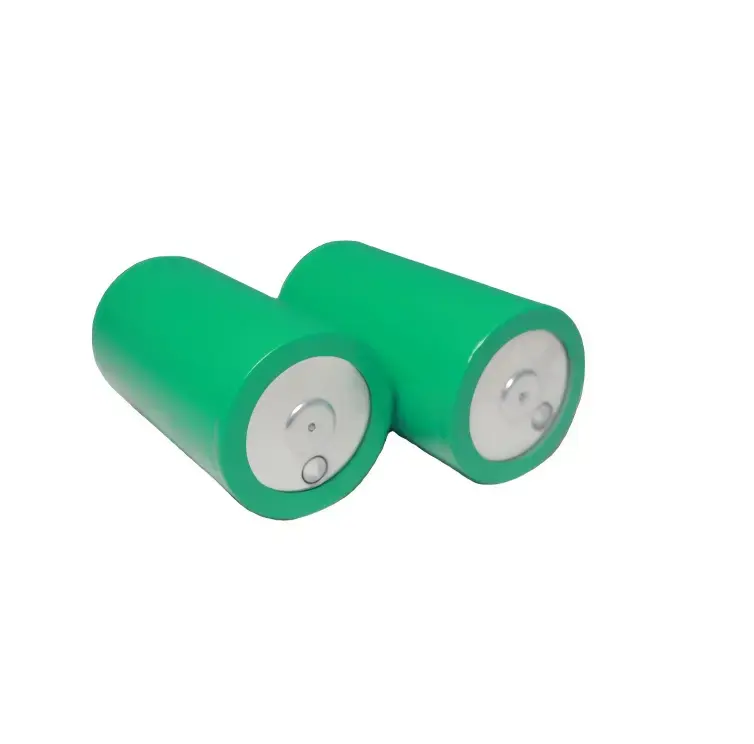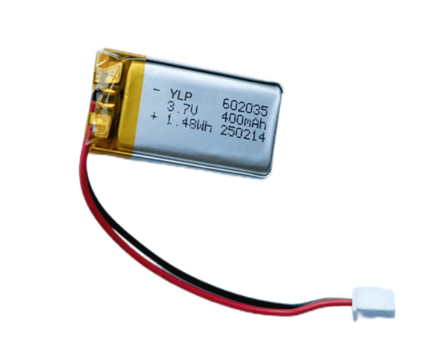


If you are developing outdoor monitoring devices or offshore buoy systems, you will almost certainly rely on a single-cell 3.7V lithium-ion battery as the core power source. It is simple in structure and easy to integrate into circuit design. However, in real-world field applications, even batteries with the same 3.7V rating can show huge differences in performance—some systems run for over a year, while others fail within six months.
The difference is usually not the brand of the cell itself, but whether key selection parameters were properly considered.
Why 3.7V Has Become the “Default” for Low-Power Industrial Devices?
The nominal voltage of a typical lithium-ion (ternary) cell is 3.7V, with a standard full-charge cutoff at 4.2V. The discharge cutoff can reach around 2.75V under ideal conditions. However, continuously discharging to the absolute limit will significantly shorten cycle life.
For long-term low-power industrial devices, engineers usually set the Battery Management System (BMS) cutoff around 3.0V, leaving about 0.25V of safety margin. This helps prevent deep discharge damage to the internal structure of the cell.
The real performance difference comes from the discharge curve. A 3.7V ternary lithium cell has a relatively flat voltage drop during discharge. Sensitive components such as MCUs, RF modules, and sensors are highly dependent on stable voltage. Even small voltage fluctuations may cause data drift or communication interruptions, which are difficult to diagnose in field deployments.
Cylindrical vs. Pouch Cells: Choose Based on Space and Production Scale
There are two mainstream types of 3.7V lithium batteries. The choice is not about which is better, but which is more suitable.
1. Cylindrical Cells (e.g., 18650 / 21700):
High consistency in mass production
Lower pack (PACK) cost
Suitable for standardized industrial devices with stable annual demand
Best for products with structured internal cylindrical battery compartments
2. Pouch (Polymer) Cells:
Flexible shape design (thin or custom geometries possible)
Suitable for handheld devices or compact instruments
Higher unit cost compared to cylindrical cells
Slightly lower consistency in very large-scale production
Both types can be customized in capacity according to device power consumption. Industrial-grade BMS protection boards typically integrate overcharge, over-discharge, short-circuit, and over-temperature protection. Advanced systems may also include balancing and communication interfaces.
For exports to Europe, the US, or Southeast Asia, compliance with certifications such as UN38.3 and IEC62133 should be confirmed.
Case Study: Offshore Buoy Running for One Year with 21700 Cells
Shenzhen Yilai Technology once provided a power system solution for a long-range offshore signal buoy. The device was permanently anchored at sea and periodically collected and transmitted hydrological and positioning data.
The biggest requirements were:
Continuous operation for over one year after full charge
Resistance to salt spray corrosion
Since there is no charging condition at sea and the battery compartment is sealed, replacement is impossible.
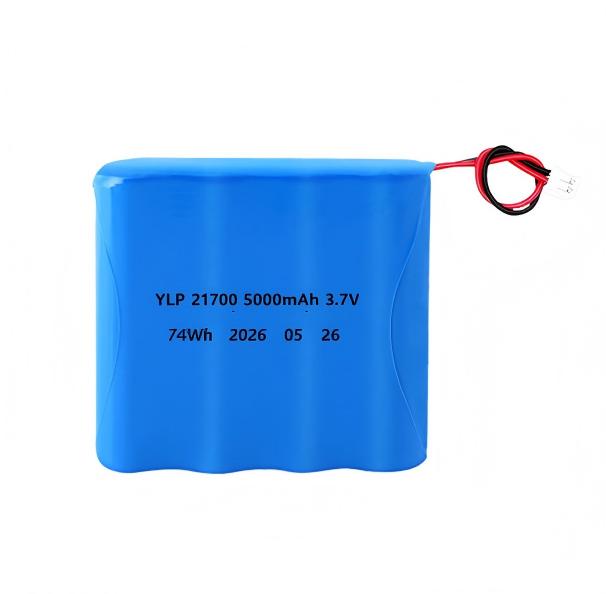
Through real power consumption profiling, it was found that the ultra-low-power stage required microamp-level current; otherwise, even high-capacity batteries would be depleted within three months.Final solution: A 1S4P configuration using four 5000mAh industrial low self-discharge 21700 premium cells, forming a 20Ah battery pack.
Measured data of the cells:
28-day storage at 25°C: capacity retention > 98.5%
28-day accelerated aging at 60°C: retention > 93.5%
Recovery rate after aging: > 98%
Even under harsh marine conditions with large day-night temperature differences, self-discharge remained under control.
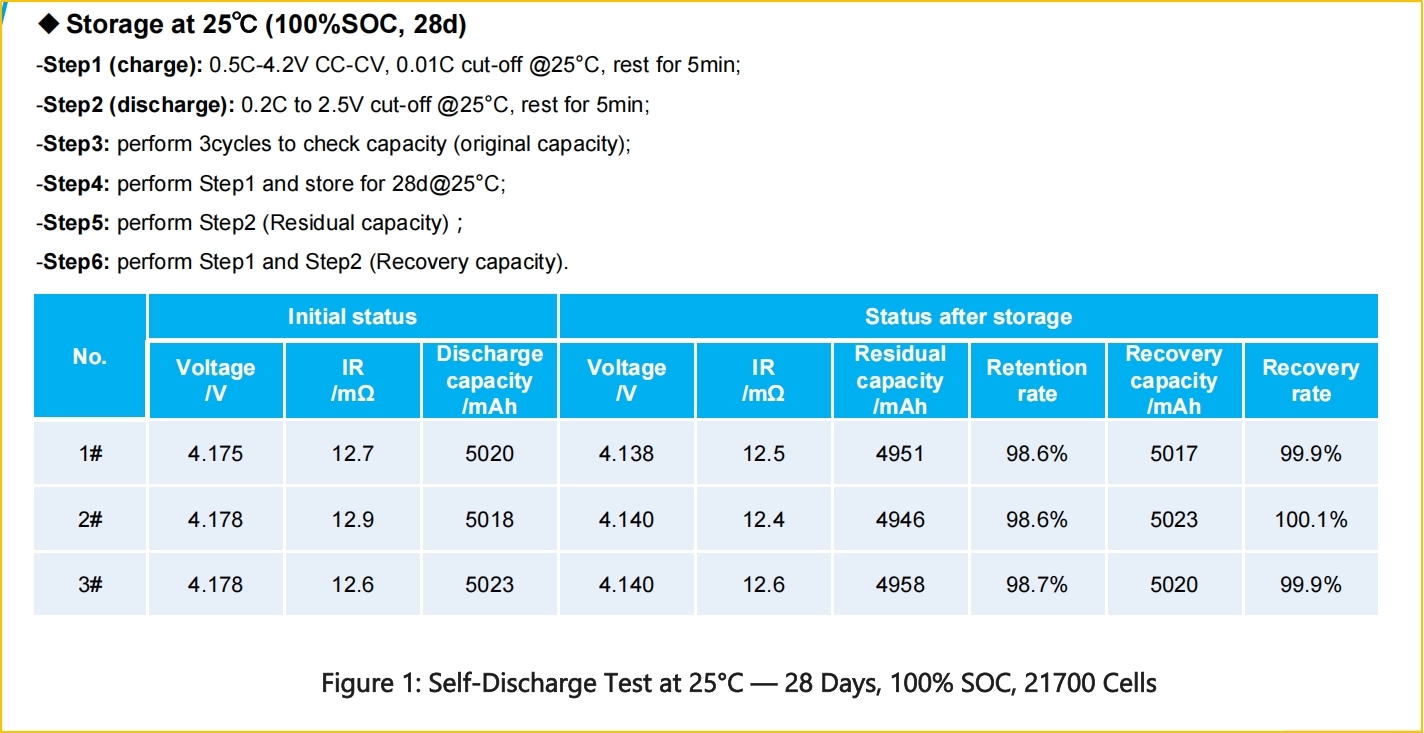
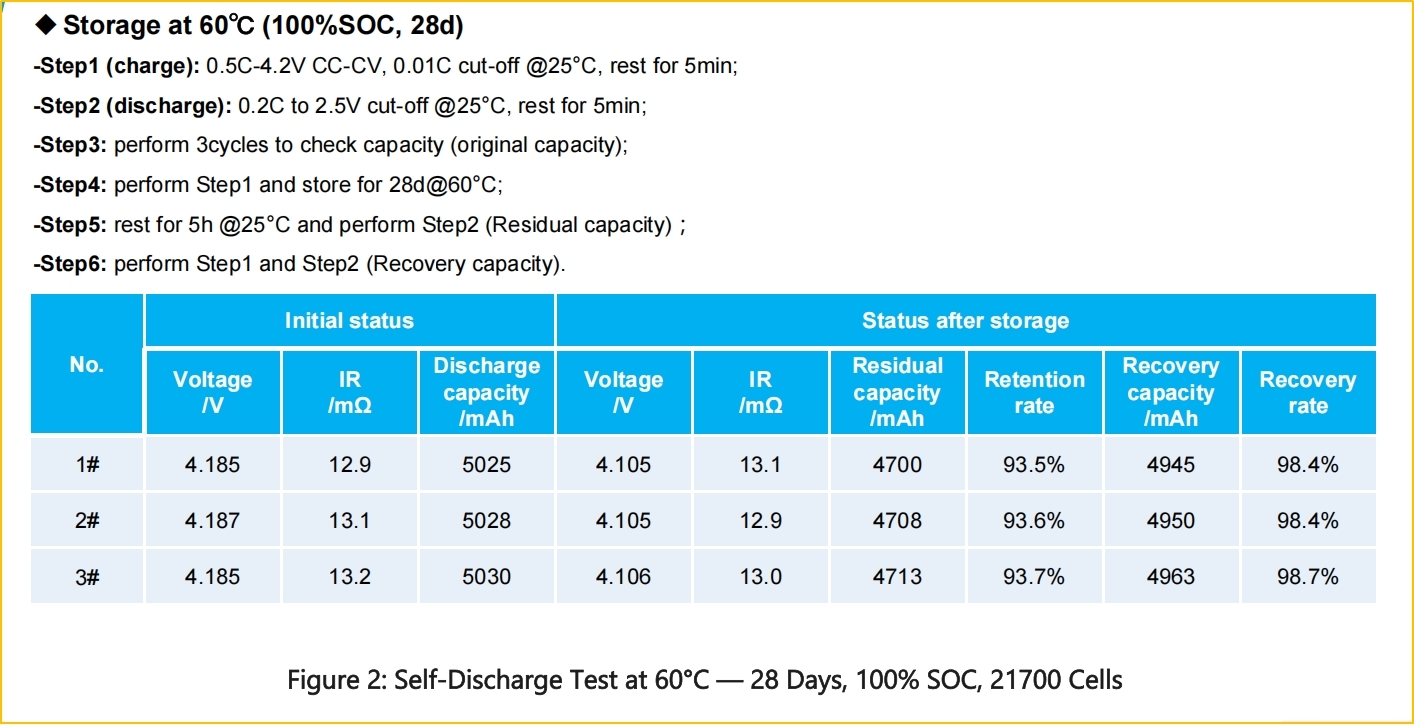
Additionally, the BMS used ultra-low-power design with static current in the microamp range (as low as 3μA in standby).
The entire battery pack was also sealed with anti-corrosion encapsulation to withstand high salinity and temperature variation (from ~5°C at night to over 40°C during daytime exposure).
After deployment, the system has been operating continuously for over a year with stable signal transmission and no interruptions. Battery degradation remained within expected range, significantly reducing maintenance and vessel inspection costs.
3.7V Lithium Battery Selection Checklist
For industrial outdoor or offshore long-term applications, it is recommended to verify the following key factors before purchasing:
1. Self-discharge rate:Cells with monthly self-discharge above 3% at room temperature are not suitable for long standby applications. Prefer low self-discharge industrial-grade cylindrical cells.
2. BMS cutoff voltage:Confirm the real discharge cutoff of the protection board. It is recommended to set it at 3.0V instead of the absolute 2.75V limit. This slightly reduces usable capacity but significantly extends cycle life.
3. Protection and encapsulation:Is the device exposed to water or salt spray? If yes, waterproof and anti-corrosion encapsulation must be applied at the PACK level. Simple heat shrink is not sufficient.
4. Cell matching consistency:For batch production, request cell grading and matching data from the supplier. If internal resistance and capacity variations are too large within the same batch, the overall pack performance will degrade.
In short, prioritize self-discharge rate, packaging process, and cell consistency first, then calculate capacity based on actual power consumption.
If you are unsure about matching power consumption and capacity, you can request a reference calculation sheet for similar projects to make evaluation easier.
Common Questions About Selection
Q1: Does setting BMS cutoff at 3.0V instead of 2.75V significantly reduce usable capacity?
Not significantly. Below 3.0V, a ternary lithium cell typically only has about 3%–5% remaining capacity. The impact on runtime is minimal. However, raising the cutoff improves cycle life by over 30% by preventing lithium plating and copper dissolution. For long-term unattended systems, this trade-off is very worthwhile.
Q2: In a multi-cell parallel pack (e.g., 1S4P), will one aging cell affect the others?
Yes. Cells with higher internal resistance or lower voltage will become a “load” and continuously absorb energy from healthier cells, accelerating overall degradation. This is why cell matching is essential. Voltage deviation should be controlled within 5mV and internal resistance difference within 3mΩ for low-power long-life systems.
Q3: The device has low average current but peak RF pulses up to 2A+. What should be considered?
Even with low average power, RF modules (e.g., Bluetooth) can draw 2A–3A pulse current during transmission. If a high-capacity cell is used instead of a high-rate cell, voltage may drop sharply during pulses, causing MCU resets or transmission failures.
Two solutions:
Use cells supporting 1C–2C discharge rates
Add a large low-ESR capacitor (≥1000μF) at the output for transient buffering
Both methods have been successfully applied in Yilai’s custom industrial projects.
Q4: After waterproof encapsulation, can individual cell voltages still be measured?
Not recommended to disassemble sealed packs, as it will damage waterproofing and lead to corrosion or short circuits. Instead, design the pack with external sampling wires or a communication-enabled BMS interface to monitor cell groups without opening the pack.
If periodic inspection is required, detection ports should be reserved during design and specified before production.
 en
en
 English
  français
  Deutsch
  Español
  italiano
  português